One of the key concessions made by the Conservative Party as part of the Coalition Deal with the Liberal Democrats was to guarantee a referendum on electoral reform within the life of the current Parliament. Commentators speculate that such a referendum could come as early as next year.
The interesting part of this will be the campaigning. The idea that this concession was hard to win for the Liberal Democrats is evidenced by the fact that the Conservative Party will be free to campaign against Proportional Representation, whilst their new found friends will be going big-guns on trying to ensure a "yes" vote at the polls.
Electoral reform is something that has cropped up every now and then ever since the Liberal Democrats came into existence in the 1980s, but strangely enough it is something that most of the electorate still know nothing about; especially when it comes to what it would mean for Parliament. To this end The Guardian produced the graphic below, extrapolating the 2010 General Election result to cater for the various systems.
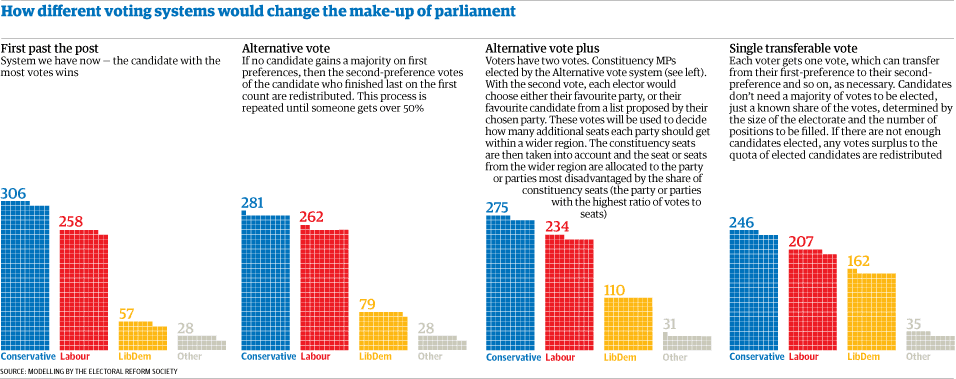
"How different voting systems would change the make-up of Parliament" - The Guardian
(Click for bigger)
As you can see, whilst the order of the parties remains the same, the number of seats attained by each party differs. Not so much for Labour, The Conservatives and the "Other Parties", but dramatically so for the Liberal Democrats. Then again, why would they spend so much time and effort campaigning for electoral reform if they weren't going to benefit from it?
It doesn't take a degree in Political Science to guess that the system that the Liberal Democrats want to push though is Single Transferable Vote. Even if you discount the fact that it is the system that would do them most justice, you can see why: on face value it appears to be the fairest of the systems. The number of seats attained correlates much better to the number of votes received. Fairer for the parties, perhaps, but not for the electorate.
You see, the main problem with STV is that it removes the concept of the constituency as we know it: one vote, one seat. As you can guess, it would be impossible to proportion one seat between two or three parties. Instead voting would take place in larger constituencies, or regions, with voters electing MPs for maybe five or six seats.
Sound familiar? It should.
Those of you who voted in the European Parliament elections in 2009 will have encountered a similar system. In the European Parliament the UK is divided up into twelve regions, each returning anywhere between three and ten MEPs. The regions themselves are of enormous size, taking in anywhere up to around 100 UK constituencies.
So what's the problem?
Under the current First Past the Post system (or even under the Alternative Vote system, which I am in favour of) you vote for one MP in one seat. This seat generally covers all or part of a city, or a number of contiguous small towns and villages. This, in my mind, is perfect in that the MP is responsible for a relatively small area (which they generally come from in the first place) and can easily represent the area based on an in-depth local knowledge. The constituents have one MP with a high local profile and therefore have one effective port of call for their problems.
Under STV, the area covered would be larger (an entire county for example) with a greater number of representatives. This leads to two potential problems:
- Uncertainty: A larger number of MPs could create confusion within the electorate. People may not know who their MPs are (more MPs means more to remember) or may not know who to go to for help. It could also lead to higher-profile MPs ending up with more work, whilst their lesser-known colleagues get an easy ride.
- Disproportionate Representation: It could well be that the five or six MPs in a particular region all come from the same town. This would mean that they may not have the base of knowledge to deal with issues affecting other parts of their constituency. This could be particularly appropriate in constituencies with an urban/rural mix.
To conclude, the key benefit of the Constituency Link is accountability. You have one MP who bears supreme responsibility for the interests of their constituents. This makes it easy to hold them to account come election time. More MPs would result in confusion and just general buck-passing.
We just have to accept it: sometimes less really is more.


 Posts
Posts


oh come on! the idea that most of the MP's gaining the most votes coming from one specific town seem to be highly unlikely. And of course people would know how to get help. IT wouldnt be that difficult - check local government website, go to some sort fo contact page with the appropriate MP's contact details for the appropriate issue.
ReplyDeleteSometimes having just one MP representing an area isnt good because they may have gained the most votes but they wont represent the entire views of that population. So having a few MP's may lead to different views being heard. In the last election my area's MP was not good and I just thought to myself why have we got this man running our constituency.
Jabed
ReplyDeleteI accept what you are saying about it being unlikely, but it is still a distinct possibility that the MPs selected don't cover the entire geographical area of the constituency.
To dress it up differently, I'm sure you can envisage all the MPs in Norfolk (saying that Norfolk becomes a constituency, for argument's sake) coming from urban areas. This would result in the loss of rural knowledge that MPs such as Richard Bacon possess and a lack of 'quality of service' for the rural electorate.
As for ease of identifying one's MP, I agree with your points as far as those from our age group are concerned (if they even bother to take an interest...). The main problem would be for the older members of the community who may not be so technologically advanced as us.
As far as your comments about the problems of having one MP are concerned, would you not be open to the suggestion that it is as a result of a problem with the MP's attitude rather than a problem inherent with the system?