Monday, 19 April 2010

The Big Boundary Con (Part Deux)

A couple of weeks back I blogged about the fact that the electoral system in the UK is somewhat biased in favour of the Labour party; using the example that with Labour and the Conservatives both gaining 35% of the vote, Labour would have about 100 more seats.  Given the commentary there has been recently on the surge that the Liberal Democrats have experienced, this seems like an ideal time to revisit the issue.

An opinion poll published yesterday for The Sunday Times showed Labour lying in third place following the Leaders' Debate on Thursday evening.  The figures were:

Conservatives: 31%
Liberal Democrats: 29%
Labour: 27%
Others: 13%

If you feed this data into the BBC calculator, you get something that looks like this:
National result based on ComRes poll for Sunday Times (18/04/2010)

Now if you look closely at the figures and the outcome, you may well notice that something appears to be amiss.  Namely, the fact that Labour are lying in third place but that they still have the most seats.  As well as that, take a look at the Liberal Democrats.  They are two points ahead of Labour and two points behind the Conservatives, but they still trail both parties by 175 and 134 seats respectively.

This got me thinking, and I ended up having a little play with the calculator.  I decided to see how low I could take the Labour vote share whilst still keeping them as the largest party.  This was the result:

National result based on my own input

The figures I used in the above example are as follows:

Other: 30.7%
Liberal Democrats: 29.8%
Conservative: 22.6%
Labour: 16.9%

As you can see, the Labour party are now the fourth placed party in terms of popular vote but still remain as the largest party in the House of Commons.  In fact, the number of seats is the complete opposite of the share of the vote.  The biggest injustice here is the number of seats gained by "other parties".  In return for almost one third of the popular vote they receive just one twentieth of the seats in the House.

When the least popular party can still be the largest party in the House of Commons, it is clear that there is something fundamentally wrong with our political system which must be changed as soon as possible, and I will discuss that in my next post (hopefully tomorrow!).

In the meantime, please have a play with the calculator (here) and let me know if you can keep Labour as the largest party with a vote share of less than 16.9%.

Sunday, 18 April 2010

The Clegg Effect

First, my apologies for the lack of comment and coverage of late.  I'm back in the UK working on Chloe Smith's campaign in Norwich North and it's taking up a lot of my time.  I shall try and keep you updated but I promise you that normal service will be resumed after the election at the latest.


I will freely and happily admit that Nick Clegg won the debate on Thursday by a country mile.  In retrospect, I guess it was the result that anyone remotely tuned into politics should have expected.  The consequence is a surge in Lib Dem support which, if sustained, gives rise to the real possibility of a sea-change in British politics and the emergence of a genuine three-party system.


Personally, I was a little surprised at the effectiveness of Clegg's technique; not looking straight down the camera was one of the first things I was taught in a media-relations course a couple of years back.  However, it must have struck a chord with the British public and combined with his approach to win over large chunks of the electorate.


The big question now is how long that effect will last.


What the Lib Dems will be hoping for is a permanent shift in public sentiment (or until May 7th at least!) which has thrust their party into prominence and has seriously increased their chances of being able to act as king-maker in a hung Parliament.


What Labour and the Conservatives will be hoping for is a short-term fluctuation, which will subside within the  next few days.


Should we head into next Thursday's debate with the landscape still showing a Lib Dem surge, Brown and Cameron will be faced with some tough decisions.  Namely, those surrounding how to deal with Clegg.  (Well... actually, that's not quite true.  Given the number of times Brown declared "I agree with Nick", last Thursday, I'm sure he would be quite happy to sit back and let the Lib Dems win the election for him).


The problem is this:

The Liberal Democrats have prepared their manifesto from their position as a third-place party.  Therefore, they'll have done it in the mindset of being able to promise the moon on a stick whilst being safe in the knowledge that they'll never have to deliver on these promises.  The danger comes now that they are showing real potential.

David Cameron needs to capitalise on this and make sure the public are left in no doubt come 2200hrs on Thursday that this is the case.  He needs to make it crystal clear that a vote for the Liberal Democrats is not just a vote for Labour (as he has been doing anyway), but also a vote for a party who didn't even expect to be running the country come May 7th, let alone a party who are not even ready for such a responsibility.

Whilst this may be relatively easy to do, the challenge for Cameron will be his delivery.  He needs to be able to present these facts from a position of strength and wisdom and not just come across as a worried and petulant little boy (as Clegg so often has the propensity to do).

One thing, however, is certain.  Should the unthinkable occur and we awake on May 7th under a Lib Dem government, we will wake to a strange and unusual sound.  The sound of Nick Clegg simultaneously laughing his socks off whilst soiling himself at the prospect of what he has let himself in for.

Friday, 9 April 2010

The big boundary con

The upcoming election will be fought on new boundaries in many constituencies, as well as in a small number of new constituencies.  The boundary review that brought this about was intended to even up the size of constituencies (to an average of between 70,000 and 80,000) and to end the anomaly of the party with the most votes not necessarily winning the election.


However, it does not appear to have worked.  Far from it.

A report in this morning's copy of The Sun illustrates just how bad the system still is:


As you can see, if Labour and the Conservatives get an equal share of the popular vote at 35% each, Labour still manage to end up with almost 100 more seats than the Tories; in fact they end up with the magical 326 seats needed to form a majority in the House.  On the other hand, the Tories need to get over 40% of the vote to get even the slimmest of majorities.

How is this fair?

The main problem lies in the distribution of the constituencies.  In the Labour strongholds of Scotland, Northern England and the inner cities, the Labour party enjoys much smaller populations, with the smallest being around 22,000 in northern Scotland.

The Conservatives, on the other hand, enjoy their greatest support in the Shires and the southern constituencies.  They hold the "largest" constituency, the Isle of Wight, with a population of approx 110,000.

This shows a marked difference in the effort required on the part of the major parties.  Whereas Labour only need between 10,000 and 20,000 votes to win 50% of the vote in many of their constituencies, the Conservatives need to poll over 55,000 votes on the Isle of Wight in order to win the same percentage.  This means that Labour are able to win almost five constituencies in comparison to one for the Conservatives.

What is needed is not the token realignments of the last boundary review (which, for the record, boosted Labour's vote in a number of key constituencies at the expense of the Conservatives) but a root-and-branch review.  The Boundary Commission say that the physical size of constituencies is not taken into consideration, so they should prove this.  If Scotland needs giant constituencies up in the Highlands and Islands in order to find 70,000 voters then so be it.  Not only will it increase the fairness in the system, but it will also reduce the costs by slashing the number of MPs.

Unfortunately, it is too late for any changes to level the playing field in time for May, so this will just remain another factor in Labour's favour.  The consequences are clear, the Conservatives will have to work five times as hard as Labour if this country is to get the change it needs.

Wednesday, 7 April 2010

So he's rich. So what.

Over the last 24 hours, Labour and their pet newspapers have attempted to draw a very clear line in the sand; giving the clearest indicator yet as to the lines on which they will be fighting this election.


If you take a look at the political coverage on The Mirror's website today, you will find yourself unable to move for the multitude of stories imploring voters to avoid David Cameron based solely on his upbringing.  The popular press would have you believe that his privileged upbringing makes him completely unable to relate to the man-in-the-street and therefore makes him unsuitable to lead our country.

But why should the wealth or background of a political leader have any bearing on their party's ability to govern?  Is it really fair to condemn David Cameron for something he had no choice over?

The press would like you to believe that Cameron made a conscious choice to be born into a life of privilege; nothing could be further from the truth.  The fact of the matter is that it could so easily have been any one of us.  As the man himself admits, he was very fortunate.  But that is it; he is nothing more than a very lucky man.

As for the allegations that he has none of the life-experiences that any Prime Minister needs; they may have a point.  But that is where his Cabinet will come in.

In the leader-focussed world of today's politics, the press seem to forget (when it suits them) that we are not electing a President, rather a team of people who are united in their beliefs and visions for this country.  They have been assembled to pool their vast experience in order to create a working, competent government.  They are there to share their experience with each other, to fill the gaps and to help the government arrive at workable, realistic decisions.

Let me be clear here, the plutocratic Conservative Party of the past is long gone; and it died longer ago than you may care to think.

Edward Heath was of a humble background, as was Margaret Thatcher.  People are always surprised when I tell them that John Major grew up in a Brixton slum, went to a normal state school and left at age 16 with three GCSEs.  The modern Conservative Party is a meritocracy, plain and simple.  Are we supposed to deny the leadership to the best candidates just because they come from a wealthy background?

Simply put, a preoccupation with the background of our potential leaders has the serious potential to backfire and leave us poorer, politically, for it.

In fact, since Alec Douglas-Home (46 years and eight Prime Ministers ago) there has been only one privately-educated Prime Minister; a certain Anthony Charles Lynton Blair and, the wars aside, he probably wasn't too bad.


Tuesday, 6 April 2010

My predictions...

As up-in-the-air as it all is at the moment, no major event would be complete without a set of predictions; so here I go!  Feel free to add your own and we'll see how they do come May 7th...


Overall result:
Conservative majority of 12


Uniform National Swing (nearest 0.5%):
7%


Seats:
Con: 331
Lab: 237
Lib: 55
Oth: 27


Turnout:
65%


Popular Vote:
Con: 10m
Lab: 9.5m
Lib: 6m
Oth: 4.5m


Green Seats:
1 (Brighton Pavillion)


BNP Seats:
0 (But a strong performance)


Speaker's Seat:
Safe, but he'll be a normal MP again within a month


Major Upset:
Ed Balls

And they're off!

Well, that's it, the cat is well and truly out of the bag and the best-kept secret of modern politics is now public knowledge.  The General Election will be held on May 6th 2010.  The next month will see campaigning activity intensify to tremendous levels as the three major parties jostle to convince us that they offer us the best chance of getting this once great country back on its feet again.


For the first time since the 1987 General Election, David Cameron's Conservative party go into the final month with a clear lead in the polls (an average of 8% based on last night's polls) and will be looking to convert that advantage into votes on May 6th.

As David Cameron has always been quick to say, it is by no means won or lost yet and every action over the coming 30 days will make all the difference.  The one thing that is certain is that the next 30 days will shape the future of this country over the next five years, and Britain will wake up on May 7th either richer or poorer for the decision it makes.

Monday, 5 April 2010

Darling predicts the future

Labour's planned National Insurance increase looks more and more likely to become one of the key themes of the General Election.  Following the boost given to Conservative support following George Osborne's pledge not to implement the increase, the Chancellor has now defended his plans.


In a report by the BBC this morning, Alistair Darling is quoted as saying that the planned 1% increase in National Insurance (for both employees and employers) will not lead to job losses.

How can the Chancellor come out and say this with such certainty?  We all know how brilliant the Chancellor is at making forecasts and predictions from the amount of revisions he had to reveal in his Budget report two weeks ago.  To say that increasing the cost of employing people will not lead to job losses is like Rupert Murdoch saying that his decision to charge for access to the Times website will not lead to a loss in readership.

It would appear now that in desperation, the Labour Party are turning away from Government by facts and instead are turning to Government by crystal ball.

Saturday, 3 April 2010

Ashes to Ashes: The bells are tolling for Labour's campaign

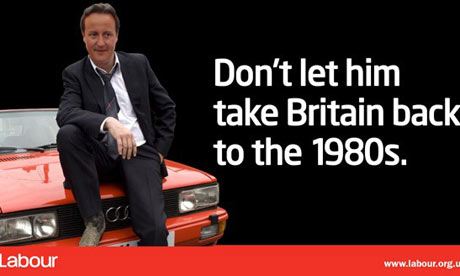
Following The Guardian's cracking set of mock Labour campaign posters for April Fools Day, Labour appear to have gotten in on the act too.  However, the best bit (from a Conservative point of view) is that unlike the Guardian's creations, theirs will be hitting 850 advertising sites in the UK as of Monday.

If they weren't who they were, you'd almost be tempted to feel sorry for Labour.  Having to fight an election campaign on meagre funds whilst their main opponents enjoy the talent of the advertising gurus M&C Saatchi with their seemingly bottomless campaign funds.  Labour, on the other hand, have had to turn to their supporters for their next poster; running a competition for Labour supporters to design the next phase in their attempt to win a fourth term in power.

Last night, The Guardian revealed that this was the winner:

(Winning design by Jacob Quagliozzi, 24-year-old Labour supporter from St Albans)

My first reaction (along with that of many others) was one of total disbelief.  Surely this had to be a late (and very bad) April Fools joke.  However, in the cold light of day this is as real as it comes.  Could it be that the Labour media machine, which was so infallible from 1997 to 2005 is slowly coming off the rails?

Here's a selection of some of the best reactions from around the web:

"Amazing. Labour's latest poster (designed by a member of the public because they can't afford a proper ad agency campaign) depicts David Cameron as Gene Hunt... one of the most popular characters on TV. You'd have thought they might have picked someone the public don't actually like. Amateur night."
(Iain Dale)

"...the image actually makes Cameron look cool, young and fairly modern."
(Labour List)

"I'm increasingly certain someone high up in in Labour HQ put a big bet on the Tories winning the election and doesn't fancy losing."
(Comment on The Guardian website)

"Back to the 80's - high growth, low tax, lower regulation, a can do attitude, Great back in Britain, defeating militant trade unions, surely that template of success is one to follow - Labour seem to have forgotten that this receipe was so good they copied it initially."
(Comment on ConservativeHome)

Don't get me wrong, I've never claimed to know too much about marketing, but surely with a poster like that the idea is to encourage people to remember everything that was bad about the 1980s, and to paint your opponent in the worst light possible?  If I'm right there, then contrasting David Cameron with Gene Hunt is a rather big own goal.

Those who know about him generally like Gene Hunt, and see him as a cool, tough, no-nonsense guy who sorts things out old-school style.  By and large, those people would most likely also agree that this country needs a "Gene Hunt" in charge.  And as for the 1980s... well... unless the Labour lot have had their heads under a rock for the last few years, they should know that the 1980s are somewhat "in" at the moment, as the success of the BBC series Ashes to Ashes will show them.

Of course, those in the blogosphere have been their usual obliging and speedy selves in coming up with much better and harder hitting responses to Labour's efforts in the form of these two posters:


Now here, not only do the posters work at illustrating their point, we also have the scary preludes to a return to the 1970s ringing fresh in our ears: increasing numbers of strikes coupled with a government that is rapidly becoming hamstrung by the vice-like grip of the unions upon it.

Quite simply, those who remember the 1980s as something bad are generally Labour supporters in the first place (the miners et. al.) whereas the rest of us will just be reminded about the fact that the country was (by and large) in a much better state back then.

In fact, the people who have the most to fear from a return to the 1980s are the Labour Party themselves.  A return to a time when they were at their lowest ebb, on the verge of going out of business.  Out of power, out of ideas and dangerously close to slipping down to third place in the pecking order.

I think this poster may well prove to be a costly own goal for Labour - especially coming at a time when the Conservative lead in the polls is gradually widening - and I shall be most interested to see how they try and come back from this one.

As a certain 1980s DCI may well say:
Fire up the Quattro, we've got a country to fix!

Friday, 2 April 2010

Bringing culture to the masses

I guess it's something that we've gotten used to in the UK; the fact that (free museums aside) if we want culture, we have to pay (often handsomely) for it.  The major problem with our system is that, nine times out of ten, a flat rate applies for all adults, effectively restricting access to those with a disposable income to spend on such things.


I used to take this for granted as being one of those things that just is, has always been, and will be until the end of time.  That is, until I moved to Berlin.

Here the attitude is quite different.  It would appear that culture is seen as a right rather than a privilege.  Not only are there the usual discounts on admission for children and pensioners but also for the disabled, the unemployed, the recipients of state benefits and also for students.

This brilliant system means that I can go and watch top class theatre and opera for under £10, and that I can visit most museums for free on a Thursday evening.  On a broader level, it means that anyone who wants to partake in such cultural gems need not be deterred by the fact that they'll have to mortgage their home to get a ticket.

Of course, it does come with its own small sacrifices.  For example, student discounts for retail are almost non-existent here.  That said though, I know I'd much rather be able to have a well-priced night at the opera rather than 50p off a CD or DVD that will only be gathering dust in six months time.

And there, I believe, lies one of the big problems with today's "broken Britain".  There exists an ever growing social group who have never experienced real culture, believing it to be beyond them.  Opting instead to define culture as not seeing a comedy at the cinema, or drinking an alcoholic beverage from a glass.

This merely reinforces the untrue belief that success is beyond them and that they will never get out of their life of run-down council estates and government dependency.

I firmly believe that culture is what makes a society great and powerful.  You only need to look at the ancient Greeks and Romans to see that.

So if we want to make Britain great again, we should start by bringing culture to the masses.

Thursday, 1 April 2010

The gloves are well and truly off

For the last couple of months or so, the attacks by both Labour and the Conservatives are hotting up. Now Labour's latest advertising campaign takes the gloves off and aims squarely for the face.


Love them or hate them, negative, attacking advertising campaigns are now becoming an integral part of politics; no more so than with the current General Election campaign.

Today, the Labour Party have unveiled a new, more aggressive campaign aimed at playing upon Brown's hard-man, bully-boy image and turning his reputation into votes.

This first image works on both fronts, not only does it emphasise Brown's reputation for aggression but it also calls into question the background of the Tory leader.

Here, Brown admits that he may not be perfect, but that he'll defend himself to the death against any accusations levelled against him by his opponents.

In this poster, marketing gurus Saatchi have managed to turn Brown's famed aggression into a selling point, painting a clear contrast between a weak David Cameron and a strong, passionate, aggressive Gordon Brown.


The message is clear, you're either with Labour or an enemy of Labour.  Don't make the wrong choice.